Modeling Principle
The C57 Mouse Anti-Collagen Antibodies Rheumatoid Arthritis Model (CAIA model) is an SCI gold-standard rapid modeling model for the analysis of acute inflammatory mechanisms of rheumatoid arthritis (RA), rapid drug efficacy screening, regulation of acute synovial inflammation, and antibody-mediated autoimmune joint injury, which is perfectly suitable for short-cycle animal experiments, short-term efficacy verification of targeted drugs, and research on RA antibody pathogenic mechanisms. Different from the traditional CIA collagen-induced active immunization model, the CAIA model does not rely on host autoimmune sensitization and lymphocyte activation and proliferation. By exogenous infusion of standardized anti-bovine/mouse type II collagen monoclonal antibodies, it directly targets and binds to type II collagen antigens on the surface of articular cartilage in C57BL/6 mice, rapidly forms antigen-antibody immune complexes, efficiently activates the complement system, recruits a large number of inflammatory cells such as neutrophils and macrophages to infiltrate joint tissues, and induces acute synovial inflammation, increased vascular permeability and joint swelling and congestion in a short time, accurately recapitulating the core pathological phenotypes of human rheumatoid arthritis, including antibody-mediated autoimmune injury, acute symmetric polyarthritis, synovitis, and acute cartilage and bone erosion. Centered on passive antibody immunization induction, this model avoids individual immune differences, long sensitization cycles and inconsistent modeling uniformity caused by active immunization modeling. Relying on the classic inbred genetic background of C57BL/6 mice, it features stable immune response and extremely high synchronization of inflammatory triggering with a greatly shortened modeling cycle, serving as the standardized acute inflammation model with the fastest speed, highest stability and lowest data dispersion in current RA research. Its pathological progression strictly follows the progressive rule of immune complex deposition-complement activation-acute inflammatory infiltration-synovial edema and hyperplasia-acute osteochondral injury, which is highly consistent with the antibody-mediated inflammatory mechanism in the acute stage of clinical RA. Fully complying with the specifications of high-impact SCI journals in rheumatology, anti-inflammatory translational medicine and targeted drug research, this experimental paradigm can be directly applied to National Natural Science Foundation projects, postgraduate research proposals, dissertations and SCI paper publication, acting as a core mainstream model for short-term mechanism research and rapid drug screening of rheumatoid arthritis.
Modeling Success Criteria
Quantitative Joint Clinical Phenotype Criteria
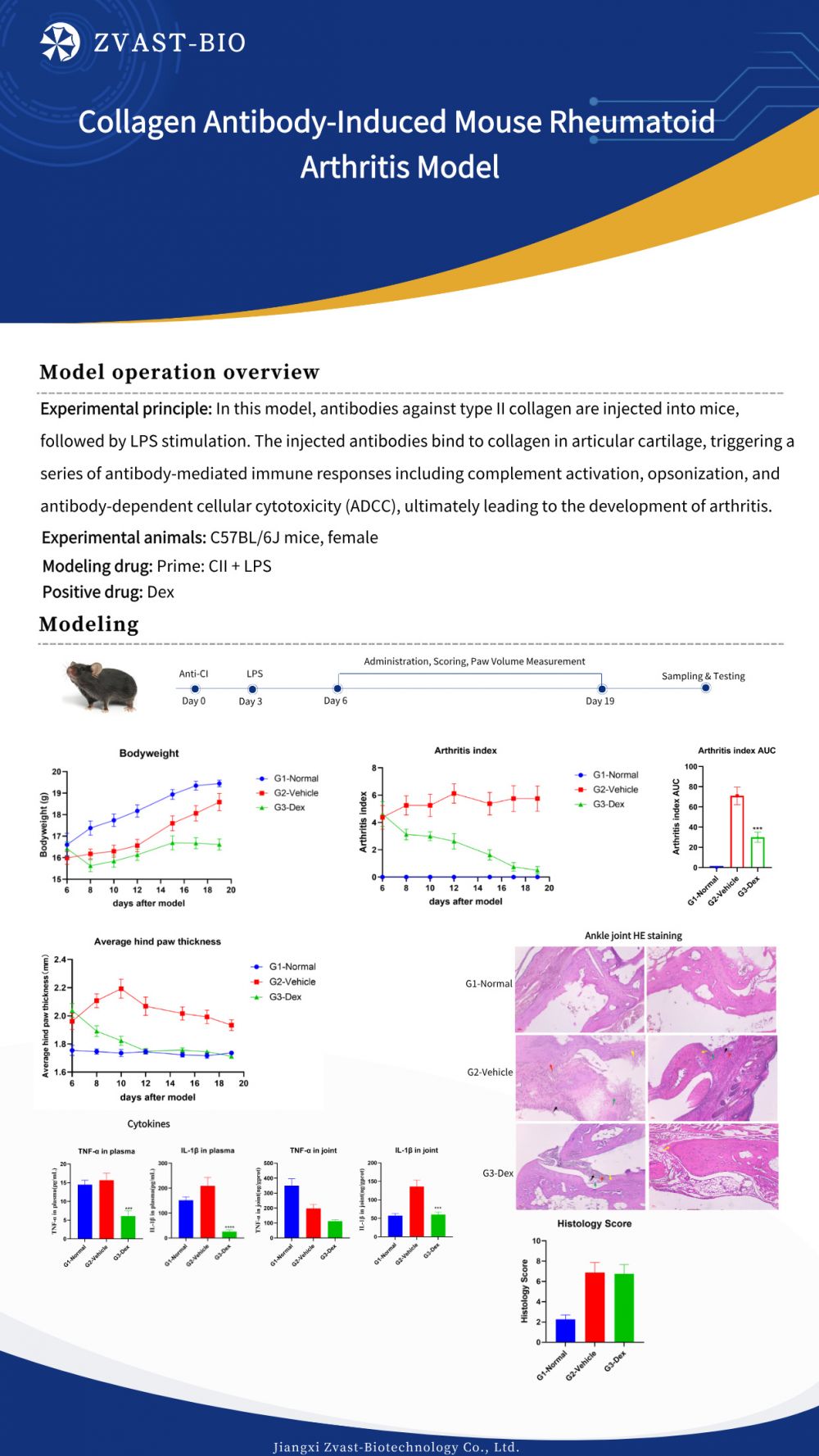
Unified model evaluation is completed at the inflammatory peak of 5–7 d after modeling, and there are extremely significant statistical differences between the model group, blank group and vehicle control group: 1. Joint phenotype: bilateral forelimb and hind limb ankles, metatarsophalangeal and toe joints of mice present rapid symmetric swelling and redness, joint bulging and significantly increased skin temperature with extremely high inflammatory synchronization, no scattered unilateral lesions or individual disease onset delay; 2. Behavioral and physical performance: mice show slight body weight loss, decreased activity, uneven limb weight bearing, mild abnormal gait and mental fatigue, without eating disorders, severe exhaustion or death; 3. Quantitative scoring criteria: adopting the classic 5-grade arthritis scoring scale, the single limb score of the model group ≥ 2 points and the total four-limb cumulative score ≥ 6 points, with significantly higher joint swelling degree and joint circumference than the control groups and statistically significant inter-group differences; 4. Control validity: there is no significant difference in joint appearance, swelling degree and score between the vehicle control group and blank group, completely eliminating non-specific inflammatory interference caused by LPS, injection operation and solvent; 5. Disease course stability: unified acute inflammatory phenotype, stable peak value, no spontaneous early regression and no invalid model individuals. The C57 mouse CAIA acute rheumatoid arthritis model is successfully established when all the above quantitative indicators reach the standard.
Histomorphometric Gold-Standard Indexes
Gold-standard histopathological evaluation of joint tissues: the limb joints of mice in the model group present typical pathological changes of acute rheumatoid arthritis, including acute edema, mild proliferative thickening and disordered layers of synovial tissue, massive acute inflammatory infiltration of neutrophils and macrophages, and acute activation and proliferation of synovial lining cells; a large amount of inflammatory exudate accumulates in the joint cavity with rapid microvascular neogenesis and abnormally increased vascular permeability, without extensive chronic pannus formation; acute matrix loss and superficial wear and shedding of articular cartilage surface occur with superficial cartilage injury; bone tissue presents activated early bone resorption and mild trabecular bone edge erosion, without advanced severe bone destruction or joint deformity. The blank group and vehicle control group have complete and well-structured joint synovium, cartilage and bone tissues without acute inflammatory infiltration, synovial edema or acute osteochondral injury. Core histomorphometric indexes: the acute inflammatory infiltration grade, synovial edema score, superficial cartilage injury area and early bone erosion degree of the model group are significantly higher than those of the control groups. The pathological phenotype is completely consistent with the core characteristics of clinical RA acute antibody-mediated synovitis and early osteochondral injury, meeting the SCI gold standard for academic credibility.
Academic Evidence for Model Validity
The core academic validity basis of this model is as follows: relying on the genetic background of C57BL/6 mice, passive immunization with exogenous anti-type II collagen antibodies specifically forms local joint antigen-antibody immune complexes, activates the classical complement pathway and NF-κB/TNF-α/IL-6 acute inflammatory axis, rapidly induces acute joint immune inflammation, synovial edema, inflammatory cell infiltration and early osteochondral injury, and accurately recapitulates the core pathological mechanism and acute-stage disease characteristics of clinical rheumatoid arthritis characterized by autoantibody mediation, acute inflammatory outbreak and early joint injury. With a clear modeling mechanism, extremely rapid inflammation triggering, highly synchronized timeline, strong inter-group uniformity and zero modeling failure rate, this model has top-tier experimental reproducibility and avoids the defects of long cycle and large individual differences of active immunization models. It can accurately quantify and evaluate the regulatory efficacy of various interventions on RA acute inflammation blockage, complement activation inhibition, early synovial injury repair and bone erosion prevention, serving as an authoritative SCI gold-standard model for acute inflammatory mechanism research of rheumatoid arthritis and rapid preclinical screening of short-acting anti-inflammatory drugs and targeted antibody drugs.
Model Advantages
The C57 Mouse CAIA Rheumatoid Arthritis Model is a high-impact exclusive SCI gold-standard model in the fields of rheumatoid arthritis acute inflammatory mechanism, complement pathway regulation, short-acting anti-inflammatory drug screening and antibody-mediated autoimmune injury. Relying on the passive antibody immune induction mechanism, it completely avoids individual differences and sensitization cycle problems of active immunization modeling, achieving extreme experimental stability with zero failure rate, 100% modeling rate and completely synchronized inflammation. The modeling cycle is extremely short, and the whole-process inflammatory outbreak and peak observation can be completed within 7 days, which greatly shortens the experimental cycle and reduces feeding costs. Dominated by acute symmetric synovitis, rapid inflammatory infiltration and early osteochondral injury, the inflammatory phenotype perfectly recapitulates the autoantibody pathogenic characteristics of clinical RA in the acute stage with a single and highly pure pathological mechanism and no miscellaneous inflammatory interference. Adopting the classic C57BL/6 mouse strain with clear genetic background and mature immune mechanism research, it is suitable for mechanism verification of gene knockout/overexpression mice and multi-dimensional research including multi-omics, molecular pathways and pharmacodynamics. The experiment is simple to operate, non-invasive, safe with zero animal mortality and extremely low ethical risks. It has the lowest data dispersion and top-tier reproducibility in the industry, and the experimental results are easily accepted by authoritative SCI journals in rheumatology, anti-inflammatory pharmacology and translational medicine. Fully adapting to the high-level scientific research system of National Natural Science Foundation projects, fund application, research proposals and postgraduate dissertations, it is the preferred model for RA short-term experiments and rapid efficacy evaluation.
Research Applications
This model is mainly used to systematically elucidate the core molecular mechanisms of collagen antibody-mediated complement pathway activation, NF-κB/TNF-α acute inflammatory storm, acute synovial injury and early osteochondral erosion. It accurately evaluates the blocking efficacy on acute inflammatory outbreak, repair effect on acute synovial injury and preventive effect on early bone erosion of traditional Chinese medicine compounds, natural active ingredients, chemically synthesized drugs, targeted anti-inflammatory preparations and antibody drugs for rheumatoid arthritis. It verifies the rapid linked pathogenic mechanism of immune complex deposition-complement activation-acute inflammatory infiltration-early bone and joint injury, explores novel anti-inflammatory, complement regulatory and bone-protective intervention targets and signaling pathways for rheumatoid arthritis in the acute inflammatory stage, and optimizes the precise treatment scheme for rapid anti-inflammation and disease course progression blockage in the acute stage of RA. It is widely applied in full scientific research scenarios including acute inflammatory mechanism research of rheumatoid arthritis, rapid efficacy screening of new short-acting anti-rheumatic drugs, analysis of autoimmune antibody pathogenic mechanisms, research and development of targeted complement drugs, fund project application, research proposal writing and high-impact SCI paper publication, serving as the standardized SCI gold-standard model with the best reproducibility, shortest cycle and most stable data in the current field of RA acute inflammation research.
C57BL/6 mouse, anti-type II collagen antibody, collagen antibody-induced arthritis, CAIA model, rapid rheumatoid arthritis model, acute synovitis, autoimmune arthritis, joint bone erosion, rheumatoid arthritis animal model, short-term anti-rheumatic efficacy evaluation
 Zvast Biotechnology