Affecting hundreds of millions of people worldwide every year! Atopic diseases usher in a breakthrough in mechanisms and a new era of targeted therapy
With the rapid development of developmental immunology, single-cell omics, and bispecific antibody technologies, the field of atopic diseases (especially atopic dermatitis) has achieved multiple original breakthroughs in both the fundamental mechanisms of disease onset and precise treatment strategies. Recently, groundbreaking studies published consecutively in top journals such as Nature and The Lancet, as well as at leading international medical conferences, combined with the advancement of innovative pipelines by local pharmaceutical companies, have provided a new perspective for these stubborn chronic inflammatory diseases, shifting from 'passive control' to 'active intervention and prevention.

source: nationaleczema
Atopic dermatitis (AD) is a systemic immune disease characterized primarily by severe itching and chronic skin lesions. The prevalence among children worldwide can reach up to 20%, while in adults it is about 5%. It is often associated with atopic comorbidities such as asthma and food allergies, forming a lifelong 'atopic march' that troubles patients.
Early-Life Immune 'Checkpoints': pii-DC Drives Long-Term Allergy Susceptibility
Allergic diseases often occur early in life, but there has long been a lack of systematic understanding of how the immune system responds to allergens at different ages. In February 2026, Nature published a study by the Icahn School of Medicine at Mount Sinai, which for the first time systematically analyzed the unique response patterns to allergens in early life and proposed the groundbreaking concept of “peripherally induced dendritic cells (pii-DCs).
source: nature
Core mechanism: Studies show that neonatal skin exposure to allergens exhibits a bifurcated immune pattern—local skin is dominated by γδ T17 cells generating a strong type 17 inflammatory response, while classical Th2 sensitization simultaneously occurs in the lymph nodes. This early inflammation has a brief time window but can have lasting effects on long-term immune outcomes: individuals exposed to allergens during the neonatal period exhibit significantly enhanced lung Th2 inflammation, eosinophil infiltration, and IgE responses upon secondary airway exposure in adulthood.
Cellular and Molecular Mechanisms: Further research reveals that this early skin inflammation is driven by dermal Vγ6 γδ T cells, which can produce IL-17A without TCR stimulation. The key upstream initiator is not the traditionally recognized migratory DC, but a type of skin-resident pii-DC that activates immune responses in situ. Neonatal cDC2 upregulate inflammatory genes such as Il12b and produce IL-23 after allergen uptake, directly activating local γδ T17 cells. Notably, this pii state is clearly age-dependent and regulated by neuroendocrine development: in the neonatal period, the hypothalamic-pituitary-adrenal axis is immature, and low glucocorticoid levels allow DCs to enter the pii state; deletion of the glucocorticoid receptor in DCs can reproduce this phenotype in adulthood.
Microenvironment Interactions and Metabolic Reprogramming: New Targets in Cellular Dialogue Microenvironment Interactions and Metabolic Reprogramming: New Targets in Cellular Dialogue
The pathological network of atopic dermatitis extends far beyond T cells; the abnormal dialogue between dendritic cells and keratinocytes, as well as lipid metabolism disorders, constitute a self-amplifying loop in disease progression.
WTAP-m6A-ALOX15 Axis: A Key Mediator of DC-Keratinocyte Dialogue
A study published in Life Sciences in 2026 delved into the role of RNA epigenetic modifications in AD. The study found that the expression of ALOX15 in dendritic cells was significantly upregulated in AD lesions and correlated with disease severity. Mechanistically, the m6A methyltransferase WTAP enhanced ALOX15 expression through m6A modification, promoting DC activation and the secretion of large amounts of inflammatory factors and arachidonic acid metabolites (LTB4, 12-HETE, 15-HETE). These metabolites further caused abnormal keratinocyte differentiation, disordered proliferation, and lipid metabolism dysfunction—hallmarks of AD phenotypic changes. The establishment of this WTAP-m6A-ALOX15 axis provides new intervention entry points for targeting “lipid metabolism reprogramming” and “DC-keratinocyte dialogue”.
source: sciencedirect
ILC2 and 'Remote Activation': Pathogenic Pathways from Skin to Gut

source: springer
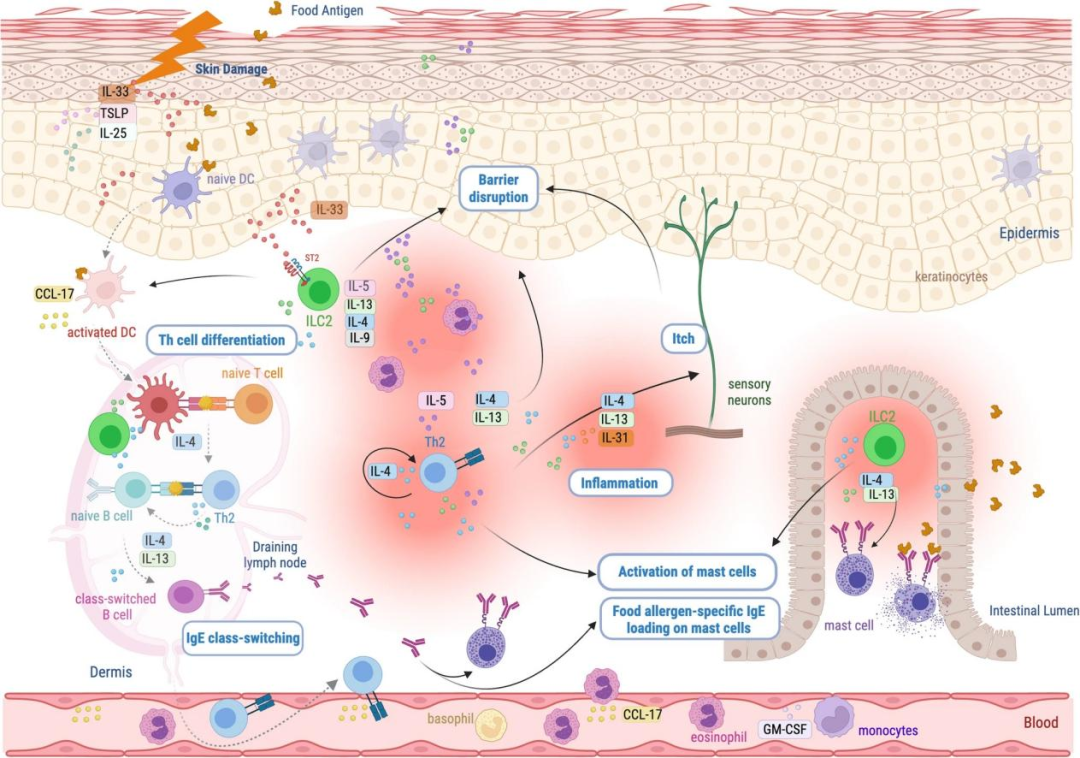
The review in Clinical Reviews in Allergy & Immunology systematically elaborates on the central role of type 2 innate lymphoid cells (ILC2) in the atopic process. In skin with barrier defects, IL-33 activates ILC2, which not only produces IL-5 and IL-13 but also promotes intestinal mast cell proliferation and IgE class switching through a 'remote activation' mechanism, thereby mediating the occurrence of food allergies. It is noteworthy that although topical corticosteroids (TCS) can improve skin lesions, in infants with AD, IL-5 and IL-13 in the stratum corneum remain elevated after TCS treatment, suggesting that ILC2 remain locally active, which explains why hormone therapy alone is difficult to block the atopic process.
source: springer
Clinical Treatment Translation: From Target Validation to Precision Intervention
The innovation of mechanisms has directly driven the upgrade of therapeutic strategies, achieving a leap from 'broad-spectrum inhibition' to 'precise blockade.' From 2025 to 2026, multiple core pathways will reach milestones in clinical validation.
OX40-OX40L Pathway: Opening a New Era of Durable Remission in AD
OX40 signaling is a key costimulatory molecule for pathogenic activation and memory formation of T cells. In 2026, The Lancet officially published the key Phase III clinical results of the OX40-targeting monoclonal antibody Rocatinlimab for the treatment of moderate to severe AD (ROCKET-IGNITE and ROCKET-HORIZON).

source: lancet
· Efficacy Breakthrough: In the ROCKET-IGNITE study, 42% of patients in the 300mg dose group achieved EASI-75 (≥75% improvement in skin lesions), significantly higher than 13% in the placebo group; the proportion of patients with a vIGA-AD score of "clear/almost clear" reached 24%. More importantly, the efficacy continued to increase over time and had not yet plateaued by the end of the 24-week study, suggesting its potential to alter the course of the disease.
· Safety: Common adverse events are mostly transient injection reactions, and the incidence of serious adverse events is low (2%-5%), comparable to the placebo group. This result not only validates the clinical value of the OX40 pathway but also provides the first targeted therapy with the potential for long-term remission for AD patients. Currently, domestic innovative pharmaceutical companies such as Bio-Thera (BAT6026, an ADCC-enhanced OX40 monoclonal antibody), Sanofi (Amlitelimab, a 'non-depleting' OX40 ligand blocker), and Pogee Therapeutics (ultra-long-acting OX40L monoclonal antibody, half-life about 60 days) are all rapidly advancing in this field.
IL-4Rα Targeted Deep Iteration: The Rise of Domestic Power and Bispecific Breakthrough
IL-4Rα, as a common receptor of the Th2 pathway, remains the cornerstone of AD treatment.
· Advancement of domestic new drug launches: In February 2026, the new drug application for Camda Biotherapeutics' IL-4Rα monoclonal antibody, Mandokimab (AK120), was accepted by the NMPA. Its Phase III clinical trials achieved statistically significant and clinically meaningful dual improvements in primary endpoints and key secondary endpoints, especially showing excellent results in early pruritus improvement indicators. This indicates that domestic IL-4Rα inhibitors are about to enter the commercialization stage, providing patients with more diverse and affordable options.

· Dual-target therapy leading the next generation: Even more groundbreaking is that Akeso Biopharma's independently developed world's first IL-4Rα/ST2 bispecific antibody AK139 has been approved to conduct seven Phase II clinical trials, including for moderate to severe AD. ST2 is the specific receptor for IL-33, and IL-33 is a key member of the alarmin family. AK139 can simultaneously block both the IL-4/IL-13 (Th2 axis) and IL-33/ST2 (innate inflammation axis) pathways. Early studies show that it demonstrates a synergistic effect significantly superior to single-target antibodies in inhibiting the release of inflammatory factors and tissue inflammatory infiltration. This marks a new era in AD treatment, moving from a single-target approach to 'dual-target synergy.'

Unlocking New Pathways: Clinical Validation of MRGPRX2 and IL-18. For patient groups with poor responses to existing therapies, drugs with entirely new mechanisms of action are entering late-stage clinical trials.
· MRGPRX2 Antagonist: Evommune's oral small-molecule MRGPRX2 antagonist EVO756 is currently undergoing a Phase IIb clinical trial for AD (data readout expected in the second half of 2026). MRGPRX2 is a receptor expressed on mast cells and sensory neurons, which can directly mediate non-IgE-dependent pseudo-allergic reactions and itching. Targeting this pathway is expected to simultaneously regulate mast cell activation and neurogenic inflammation.
· IL-18 Inhibitor: Evommune's IL-18 binding protein fusion protein EVO301 has also entered Phase II clinical trials for AD (data expected in the first half of 2026). IL-18, as a downstream effector molecule of the inflammasome, plays a driving role in certain AD subgroups.
Reshaping long-term management strategies: from controlling symptoms to intervening in the process
A 2026 study in Clinical Reviews in Allergy & Immunology emphasizes that for infant and young children with AD, the treatment goal should go beyond lesion clearance and focus on blocking the atopic process. Data show that compared with TCS monotherapy, dupilumab combined with TCS for 16 weeks can reduce IgE levels by 70% in children aged 6 months to 5 years (while the TCS monotherapy group had an increase of 30%). This suggests that early, potent targeted intervention may change the long-term allergic trajectory of affected children.
Conclusion and Outlook
Current research on atopic diseases has formed a complete mechanistic map of 'developmental origins—cellular metabolism interactions—multi-pathway network regulation,' and has rapidly translated into clinically accessible targeted strategies. From the early-life intervention window revealed by pii-DC, to the potential for durable remission targeted by OX40, and the emergence of next-generation therapies such as IL-4Rα/ST2 bispecific antibodies, we are witnessing a profound shift in atopic disease treatment from 'symptom control' to 'disease modification and prevention.'
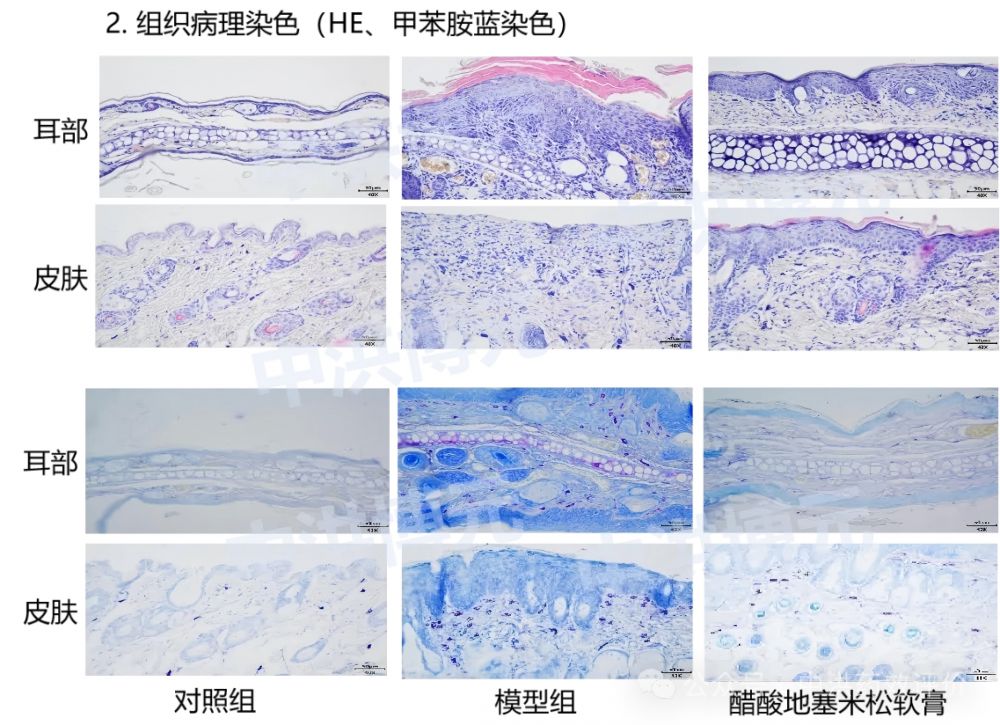
Atopic dermatitis model
Modeling method: Select healthy SPF-grade Balb/c mice, shave the neck and back area before the experiment, during modeling, evenly apply the working solution to the neck and back, and evenly apply it to the inner side of the right ear, once a day for several days.
Positive drug: Dexamethasone acetate ointment, maintain modeling during treatment.
Model