


Fighting Alzheimers: Amid Tens of Millions of New Patients Each Year, Early Screening and Targeted Degradation Bring New Hope
Alzheimer's disease (AD), as the most common neurodegenerative disease, has become one of the most severe challenges in global public health. According to the latest data from The Lancet Neurology Commission, the number of people with dementia worldwide has exceeded 57 million, with AD being the main cause, and this number is expected to surge by 2050.

For a long time, AD drug development has been mired in the quagmire of 'high failure rates.' Traditional strategies targeting amyloid-beta (Aβ) can clear plaques but are often accompanied by severe side effects such as brain edema and hemorrhage (ARIA), and the clinical cognitive benefits are limited. However, with the explosive breakthroughs in single-cell multi-omics, targeted protein degradation (TPD), and ultrasensitive blood biomarkers between 2025 and 2026, AD research is undergoing a paradigm shift from 'simply clearing pathological proteins' to 'precisely regulating the cellular microenvironment.' This article will describe the revolutionary progress in this field from three dimensions: new mechanism analysis, new technological disruption, and new target translation.
Synaptic Vesicle Protein SV2A: A Novel Upstream Mechanism Linking Synaptic Dysfunction and Aβ Production
For a long time, the deposition of Aβ has been considered the initiating factor of the AD cascade, but the upstream events that trigger APP amyloidogenic cleavage remain a mystery. The traditional view holds that synaptic vesicle protein 2A (SV2A) is only involved in synaptic vesicle cycling, and its significant decline in the early AD brain is regarded simply as a marker of synaptic loss. However, in January 2026, a study published by Peichang Wang's team at Xuanwu Hospital, Capital Medical University in Aging Cell completely overturned this understanding.

This study identified SV2A for the first time as a novel APP-binding protein. In vivo and in vitro experiments confirmed that overexpression of SV2A significantly inhibits the abnormal interaction between APP and β-secretase (BACE1) in the endosome-lysosome network, thereby remodeling the subcellular distribution of APP and 'pulling' it from the amyloidogenic pathway back to the non-amyloidogenic pathway on the cell membrane surface. In the APP/PS1 transgenic mouse model, upregulation of SV2A significantly reduced Aβ plaque deposition in the brain, and this effect was independent of its classic synaptic function.

Clinical significance: This finding not only directly links the two core pathological features of AD—synaptic dysfunction and Aβ deposition—through SV2A, but also suggests that SV2A may be an early intervention target upstream of Aβ production. Currently, PET tracers targeting SV2A have been used for synaptic density imaging, and this study lays a theoretical foundation for its translation into a therapeutic target.
Microenvironment and Cell Interaction: Oligodendrocytes and Tau Protein’s 'Epigenetic Dialogue'
The pathological progression of AD is not only an intrinsic neuronal lesion but also a complex interactive network involving multiple cell types. A major study published in *Nature Communications* in March 2026, through epigenome-wide association analysis (EWAS) of postmortem brain tissues from 472 AD cases, revealed the previously overlooked key role of oligodendrocytes in the propagation of Tau pathology.
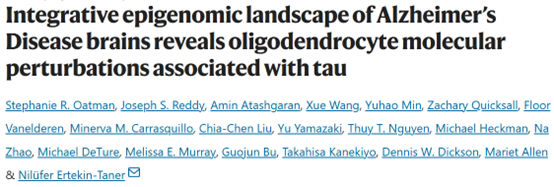
The research team used an innovative regional methylation (rCpGm) analysis method and found that over 99.7% of significant epigenetic variations were associated with the biochemical state of Tau protein (particularly membrane-bound and insoluble forms of Tau), rather than Aβ. These variations were significantly enriched in oligodendrocytes and myelination-related genes, including the known AD risk gene BIN1, as well as myelin basic protein (MBP) and myelin-associated glycoprotein (MAG). In cases of increased Tau pathology burden, DNA methylation in these regions showed significant changes, leading to dysregulation of myelin-related gene expression, which could in turn disrupt neuron-glial metabolic coupling and exacerbate axonal damage.

Clinical significance: This study, for the first time in a large cohort, mapped multi-omics epigenetic profiles in AD brains, demonstrating that Tau protein drives disease progression by affecting the epigenetics of glial cells. This suggests that future therapeutic strategies should not only protect neurons but also target the protection of myelin and oligodendrocyte functions, providing a new therapeutic window for Tauopathies.
Vascular-Immune Interaction: LRP1 and the 'Peripheral-Central' Collaborative Clearance Strategy
Research on liver fibrosis has highlighted the central driving role of vascular microcirculation disorder, and in the field of AD, blood-brain barrier (BBB) dysfunction has similarly been brought into the spotlight. In March 2026, a breakthrough study by the team of Li Wei and Hu Baoyang from the Institute of Zoology, Chinese Academy of Sciences, in collaboration with the Medical School of University of Chinese Academy of Sciences, was published in the journal Cell. They cleverly utilized low-density lipoprotein receptor-related protein 1 (LRP1) on the BBB to develop a new protein degradation technology called SPYTAC (programmable synthetic peptide-targeting chimera).

SPYTAC technology disrupts the Fc-mediated effects of traditional antibody drugs. It is a fully synthetic bispecific short peptide: one end binds Aβ, and the other end binds LRP1. By utilizing LRP1's dual natural properties of mediating transcellular transport and directing lysosomal degradation, SPYTAC can not only "hijack" Aβ in peripheral blood into cells for degradation, but also act like a "Trojan horse" to carry drugs across the BBB, entering the brain to clear Aβ plaques. In the 5xFAD mouse model, SPYTAC not only effectively reduced Aβ burden in plasma and brain tissue and significantly improved cognitive function, but more importantly, because it lacks an Fc fragment, it completely avoids excessive microglial activation and the resulting ARIA complications (such as microhemorrhages), demonstrating safety superior to that of monoclonal antibodies.
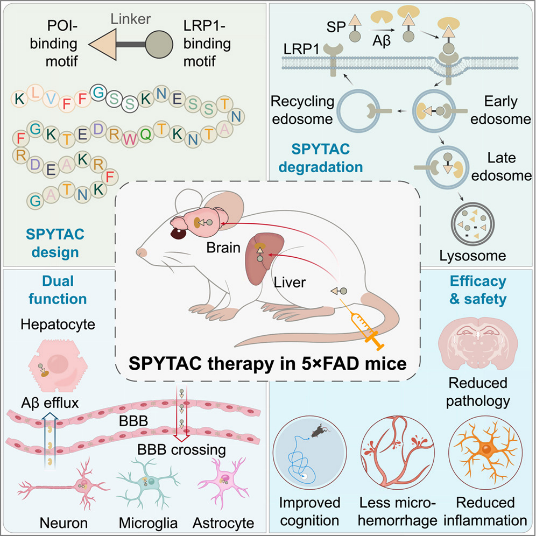
Clinical significance: SPYTAC is the first modular platform to achieve synergistic clearance of peripheral and central Aβ. It not only provides a safer therapy for AD, but its programmable features (replacing targeting peptides) also open up a general technological pathway for the clearance of other pathogenic proteins such as Tau and α-synuclein.
Clinical treatment transformation: from 'symptom modification' to 'precision prevention' and 'psychiatric symptom intervention'
The innovation of mechanisms has directly driven the explosion of clinical pipelines. AD treatment is no longer limited to delaying cognitive decline, but is moving towards the two blue oceans of ultra-early intervention and neuropsychiatric symptoms.
(1) Blood Multi-Omics Early Warning: Identify High-Risk Groups 15 Years in Advance
The premise of early intervention is the precise identification of 'preclinical AD' patients. A landmark study published in JAMA Network Open in January 2026 conducted a 15-year follow-up on nearly 300 individuals with subjective cognitive decline (SCD). The results confirmed that using Quanterix's ultra-sensitive Simoa technology to simultaneously measure four core biomarker axes—Aβ42/40 ratio (amyloid protein), p-Tau217 (Tau pathology), GFAP (neuroinflammation), and NfL (neurodegeneration)—can predict the risk of cognitive decline with extremely high accuracy (C-index up to 0.90). Multi-factor combination testing at a single time point has a prognostic value far exceeding that of p-Tau217 testing alone.

Translational Application: This marks the entry of AD screening into the era of 'multi-omics risk scoring.' Currently, the LucentAD Complete test based on this combination has been put into use, providing a powerful tool for selecting 'fast progressors' in clinical trials and for preclinical prevention.
(2) Intervention for Psychiatric Symptoms: Clinical Breakthrough of M4 Receptor-Biased Agonists
About 50% of patients with moderate to severe Alzheimer's disease (AD) experience neuropsychiatric symptoms such as agitation, but there is currently a lack of safe and effective treatments. In January 2026, NeuShen Therapeutics announced that its highly selective M4 muscarinic acetylcholine receptor positive allosteric modulator (PAM), NS-136, received FDA approval to directly enter Phase II clinical trials targeting Alzheimer’s-associated agitation (AAD). NS-136 improves agitation symptoms by modulating imbalances in the subcortical dopaminergic system, while preclinical studies have shown its potential to avoid non-selective cholinergic side effects.
(3) Next-generation Tau therapies and synaptic protection
Although some Tau antibodies have faced setbacks in clinical trials, precise Tau therapies targeting specific post-translational modifications are still progressing. At the same time, Cognition Therapeutics' oral small molecule CT1812 is undergoing a Phase IIb clinical trial for Lewy body dementia (DLB). Its mechanism involves acting on the sigma-2 receptor to block the toxic attacks of Aβ and α-synuclein on synapses, demonstrating a 'synapse-protective' differentiated strategy that does not rely on directly clearing protein aggregates.
With the validation of platform technologies such as SPYTAC and the popularization of blood multi-omics, we are standing at the turning point from 'slowing disease progression' to 'preventing cognitive decline.' In the future, as more therapies like NS-136 targeting non-cognitive symptoms are implemented, the era of precise integrated treatment for AD has already arrived.