Olfactory crossover, metabolism breakthrough — Or5v1/Olfr110 unlocks new markers for obesity
Obesity has never been a minor matter of eating a few extra bites; it is a 'silent killer' that quietly triggers diabetes, fatty liver, cardiovascular diseases, and even various cancers. On January 21, 2026, Professor Sun Jinpeng's team at Shandong University, together with teams from multiple universities and hospitals, published a groundbreaking study in Cell titled Identification of Or5v1/Olfr110 as an oxylipin receptor and anti-obesity target. This is a 'cross-disciplinary reversal': the olfactory receptor Or5v1/Olfr110, originally dedicated only to 'smelling and distinguishing flavors,' surprisingly holds hidden anti-obesity capabilities and has been confirmed as a brand-new anti-obesity target.

For a long time, obesity treatment has been a 'heavily competitive disaster zone,' constantly stuck with target mismatches and disappointing efficacy. Weight-loss metabolic surgery is traumatic and slow to recover from, making people hesitant; although GLP-1 receptor agonists are popular, they cannot escape the curse of 'losing weight while taking them, and gaining weight after stopping,' and gastrointestinal side effects cause many to give up halfway.
The starting point of this breakthrough stems from a long-standing scientific question: Oxidized lipid 12(S)-HEPE has long been proven to improve glucose metabolism and reduce fat accumulation. It is produced from EPA in fish oil through enzymatic oxidation and is a natural 'metabolic regulator,' but its specific receptor mediating its effects has remained unknown. Meanwhile, olfactory receptors, due to their generally low ligand affinity and being regarded as 'responsible only for olfactory perception,' have long been excluded from studies of oxidized lipid receptors.
The research team independently developed the 'Unknown Receptor Identification Technology Mediated by Reverse G Protein Pull-Down' (ARIG). Traditional receptor screening is like searching for a needle in a haystack, whereas ARIG technology allows 12(S)-HEPE to reconstitute the ligand-receptor complex by labeling G protein subunits, and then, combined with mass spectrometry analysis, accurately identifies the 'soulmate'—Olfr110 (the human homolog OR5V1). This solves the core problem of 'receptor identification' and opens a new world for obesity target development.
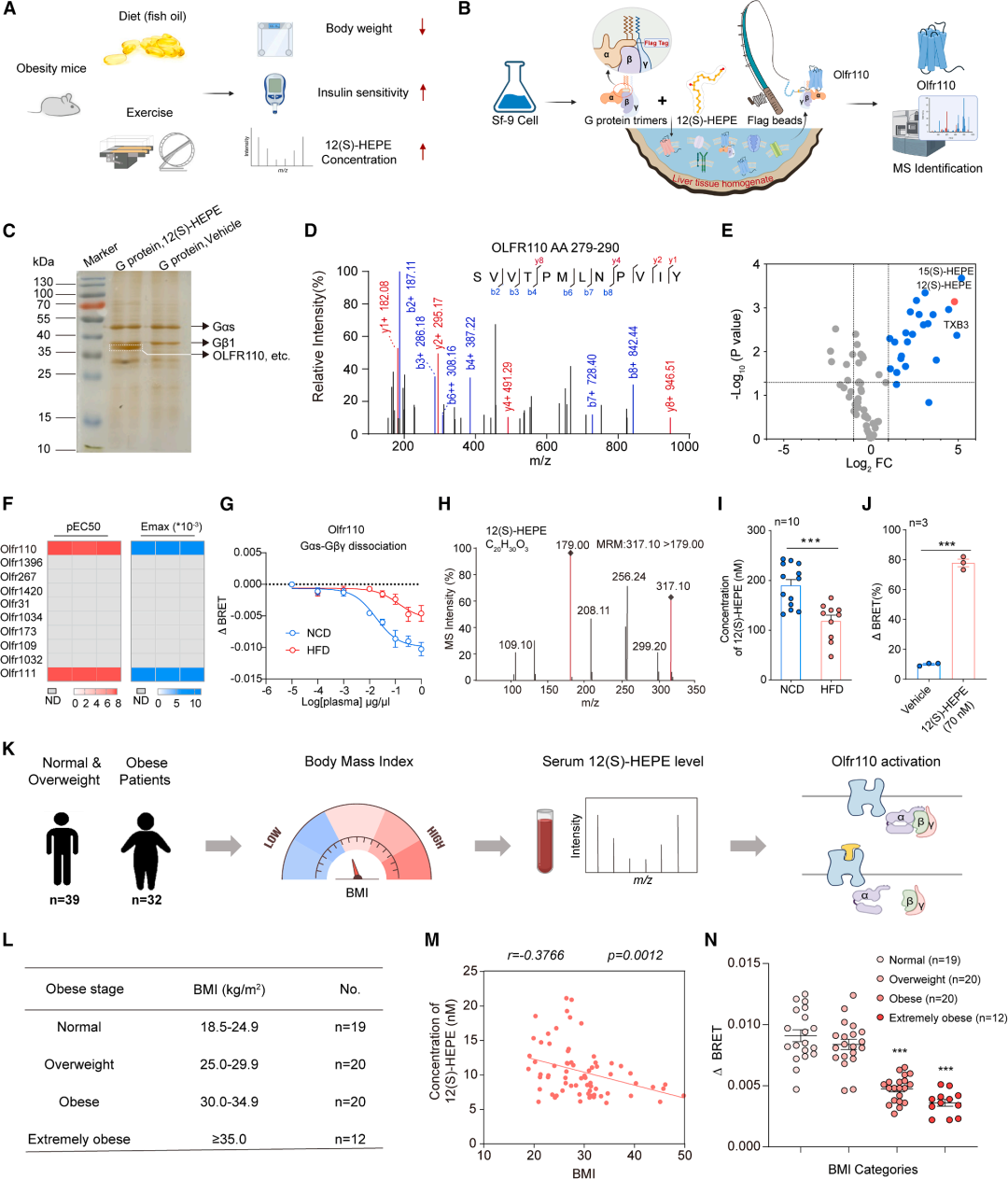
Image source: Cell Figure 2. Plasma 12(S)-HEPE levels increase after fish oil diet or exercise, which can activate Or5v1/Olfr110
In HEK293 cell experiments, the EC50 of 12(S)-HEPE activating Olfr110 was only 16.0±1.1 nM, while the concentration of 12(S)-HEPE in human serum happens to be in the optimal range of 5.9~21.1 nM. It also turned out to be at odds with BMI — the ability of serum from obese individuals to activate Olfr110 was much weaker than that of normal individuals, effectively causing the receptor to 'strike,' leading to uncontrollable body weight. Subsequent gene-edited mouse experiments directly pinpointed Olfr110's 'workplace': the liver is its 'central workstation' for regulating metabolism. Removing Olfr110 from the liver caused mice, whether on a normal diet or a high-fat diet, to become 'little chubby' and their metabolism to be in disarray; reintroducing Olfr110 to the liver enabled the mice to regain a 'slim figure.' This discovery also provides key evidence for precise drug administration in the future, avoiding 'collateral damage' to other organs.

Regulatory pathway of 12(S)-HEPE-Olfr110-Gs-PKA-pATF2-Cpt1α: After 12(S)-HEPE binds to Olfr110, it activates the Gs protein to trigger a signaling cascade, ultimately upregulating the expression of the key enzyme Cpt1α involved in fatty acid oxidation, accelerating lipid breakdown in the liver and achieving improvement in glucose homeostasis. This explains the metabolic regulatory role of 12(S)-HEPE.
Based on the crystal structure of Olfr110, the team screened a compound library of millions of molecules using AI and successfully developed the highly selective agonist HOR1-C59—its EC50 for Olfr110 is 7.12±1.57 nM, and it does not activate other homologous olfactory receptors, demonstrating extremely high specificity. In mice with high-fat diet-induced obesity, HOR1-C59 significantly suppressed weight gain, increased energy expenditure, improved glucose tolerance and liver steatosis, and these effects completely disappeared in Olfr110 knockout mice, confirming that its action strictly depends on the target. This provides a high-quality candidate molecule for oral anti-obesity drugs. This development approach, characterized by 'precise targeting, clear pathways, and controllable drugs,' represents the type of innovation most needed in the current field of obesity treatment.
Currently, the 'top trend' in the field of obesity treatment is still GLP-1RA drugs. Their short-term weight loss effects are indeed impressive, but their shortcomings are also very obvious: gastrointestinal adverse reactions often occur, with many people feeling nauseous or vomiting after taking them, and some patients experience a 'rebound' in weight one year after stopping the medication, making the efforts futile. To address this issue, a 'new generation of GLP-1RA' integrating Nobel Prize-winning theories has emerged, attempting to turn the tide by 'extending signal transmission.' However, whether it’s the old version or the new one, essentially it 'casts a wide net throughout the body,' inevitably causing 'friendly fire' and leading to systemic side effects. In contrast, Or5v1/Olfr110's 'liver-specific properties' precisely target fat without disturbing other organs, effectively managing metabolic problems while reducing side effects, forming a stark contrast to GLP-1RA.
In addition to the 'olfactory crossover' target Or5v1/Olfr110, other researchers are currently exploring novel targets such as the melanocortin 4 receptor (MC4R) and acyl-CoA synthetase 5 (ACSL5), attempting to achieve the health goal of 'losing weight without losing muscle and avoiding rebound' through multi-target synergistic regulation. WuXi AppTec, Zhonghong Boyuan, and other institutions are also simultaneously advancing innovations in preclinical models, developing obese mouse models expressing the human GIP receptor, addressing the accuracy issues in preclinical evaluation of multi-target drugs, and providing support for innovative drug development.
Research has confirmed that supplementing with fish oil or maintaining regular exercise can increase the level of 12(S)-HEPE in the body, thereby activating Olfr110 to improve metabolism—this finding organically combines 'natural intervention' with 'precision medication,' aligning with the current industry's integrated prevention and control development direction. With the popularization of health and weight management clinics in our country, this 'mechanism-clear and implementable' comprehensive approach is expected to become the mainstream model for obesity prevention and control in the future.
Of course, nothing is perfect. This study also has minor shortcomings: exactly which cells Olfr110 resides in within the liver, whether the fusion protein tag affects its working location, and whether long-term use of HOR1-C59 has any side effects—all of these still need to be gradually explored in the future.
The advantage of the Or5v1/Olfr110 target lies in its liver-specific expression, which reduces the risk of side effects. The high selectivity of HOR1-C59 avoids off-target effects, while the clear metabolic regulatory pathway provides a definite direction for subsequent drug optimization. If clinical translation can be successfully completed, this candidate drug is expected to fill the gaps of current GLP-1RA drugs.
Cross-border innovation often allows one to find a way out of desperate situations. The olfactory receptor family is like a treasure trove, with many members yet to be explored, leaving huge opportunities for research and development in obesity and metabolic diseases. In the future, with the discovery of more precise targets, the clinical translation of innovative drugs, and the improvement of comprehensive prevention and control systems, 'healthy weight loss and precise weight management' will no longer be a difficult problem, and China’s research and development will continue to lead the global direction in obesity treatment.
Introduction to the Zvast-Bio Obesity Model – Mouse Obesity Model
Obesity is a chronic metabolic disease caused by multiple factors, characterized by excessive accumulation of body fat and/or abnormal fat distribution, usually accompanied by weight gain.