


90% of Hair Loss is Because of This! Advances in Research on Androgenetic Alopecia and Introduction to AGA Animal Models
Androgenetic alopecia (AGA), also known as seborrheic hair loss, is the most common type of hair loss in clinical practice. In male AGA patients, it usually presents as gradually noticeable progressive hair loss in the frontal-temporal and vertex areas, while female patients often exhibit diffuse thinning of hair over the central top of the head and forehead, with the frontal hairline moving back less prominently.
Data shows that by the end of 2020, the population experiencing hair loss in China had exceeded 252 million, with AGA patients accounting for over 90% of cases. Although AGA does not cause physical health problems, it can affect psychological well-being, particularly in young people who often feel self-conscious due to hair loss, seriously impacting mental health.
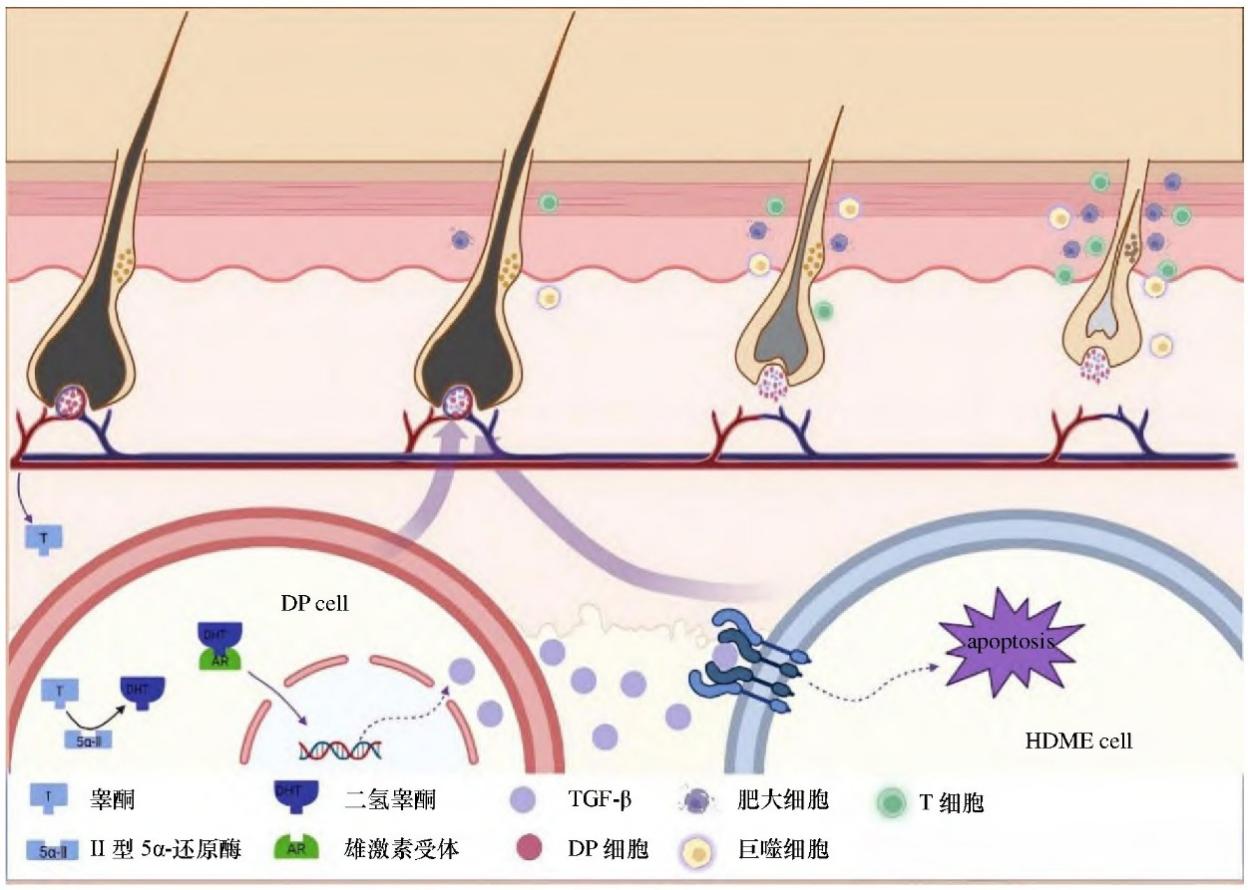
The basic pathological feature of AGA is the shortening of the hair follicle growth phase and the lengthening of the catagen and telogen phases, leading to miniaturization of hair follicles into vellus hairs and eventual shedding. AGA is closely related to androgen expression and metabolism levels, as well as downstream cytokine secretion. 5α-reductase converting testosterone (T) into dihydrotestosterone (DHT) is an important pathogenic mechanism in AGA.
In AGA patients, testosterone in the blood is converted into dihydrotestosterone by 5α-reductase, which then forms a polymer with androgen receptors (AR), inducing the dermal papilla cells to secrete transforming growth factor-β (TGF-β) and Dickkopf-related protein 1 (DKK-1).
TGF-β has been shown to induce apoptosis of microvascular endothelial cells within hair follicles, leading to the disappearance of microvessels and subsequent follicle atrophy. DKK-1 can inhibit the Wnt signaling pathway, affecting normal hair follicle cycling. Additionally, the pathogenesis of AGA is also associated with micro-inflammation and fibrosis.
Oral finasteride and topical minoxidil are currently the most common clinical treatments for AGA. Finasteride is a selective type II 5α-reductase inhibitor that can significantly reduce DHT levels in the serum, prostate, and scalp; however, adverse effects on the reproductive system are relatively common, such as decreased libido, increased body hair, breast development, and a higher incidence of high-grade prostate cancer.
Minoxidil primarily works by dilating blood vessels to achieve therapeutic effects, but its efficacy varies greatly, and patients often experience irritant or contact dermatitis, leading to scalp itching or pain.
Some patients may also experience a shedding phase. Clinically, attempts are being made to improve treatment outcomes by changing the administration methods of these two drugs, such as low-dose oral minoxidil and topical application of finasteride.
Additionally, prostaglandins (PGD), such as cetirizine, can effectively increase hair density in AGA patients with minimal adverse effects, although reports are still limited. AR inhibitors, such as spironolactone, achieve AGA treatment by blocking AR and reducing testosterone levels, but their use is restricted and generally recommended only for non-pregnant women aged 18 and above.
Botulinum toxin treats AGA by reducing scalp muscle tension, promoting vasodilation, enhancing local microcirculation, increasing oxygen supply to hair follicles, and clearing accumulated DHT. The pathogenesis of AGA is complex and involves progressive hair loss, requiring long-term treatment; therefore, more effective and safer treatment strategies are needed.
AGA animal models are important tools for studying androgenetic alopecia, often involving the injection of testosterone propionate into mice to simulate the pathophysiological state caused by androgen excess.
When constructing AGA animal models, some companies usually adopt a prophylactic drug administration approach, starting treatment at the same time as model induction. This method has certain drawbacks: since the model construction process completely overlaps with the drug treatment phase, the experimental endpoints cannot distinguish whether the phenotypic improvement is due to the drug's therapeutic effect or because the model itself did not reach the expected degree of hair loss.
This confounding factor can significantly affect the reliability of the experimental conclusions.The experimental design adopted by Jiangxi Zvast Biotechnology Co., Ltd. is as follows:
First, a 4-week model induction period is carried out to establish a stable hair loss phenotype.
Then, individuals meeting the criteria are selected based on scoring, followed by random grouping for treatment intervention.
The advantages of this method include:
(1) ensuring model uniformity through pre-screening, reducing the impact of individual differences on experimental results;
(2) data reliability: since the model status is confirmed before treatment, the true therapeutic effect of the drug can be accurately assessed, avoiding false positive or false negative results;
(3) clinical relevance: more closely simulates actual clinical scenarios, where the disease is first diagnosed before treatment is administered.
Although the experimental period is extended, the animal culling rate increases, and quality control standards are higher—resulting in increased costs—the data obtained are more suitable for IND submission review requirements.
It is recommended that clients prioritize this approach when the budget allows, to obtain more convincing preclinical research data.