for 288 Million People: Can New Dry AMD Targets + Affordable Wet AMD Drugs Safeguard Elderly People\'s Eyesight?
Gradual blurring of vision and central visual field defects are common troubles for patients with age-related macular degeneration (AMD).

Source:Neuroscience News
As the primary cause of irreversible vision loss in the elderly, the prevalence of AMD continues to expand: currently, there are approximately 20 million patients in the United States and a total of 196 million patients worldwide. It is predicted that the global number of patients will increase to 288 million by 2040. This type of disease has become a major public health issue affecting the quality of life of the elderly population.
AMD is mainly divided into two clinical types, with distinct pathological features and pathogenesis:
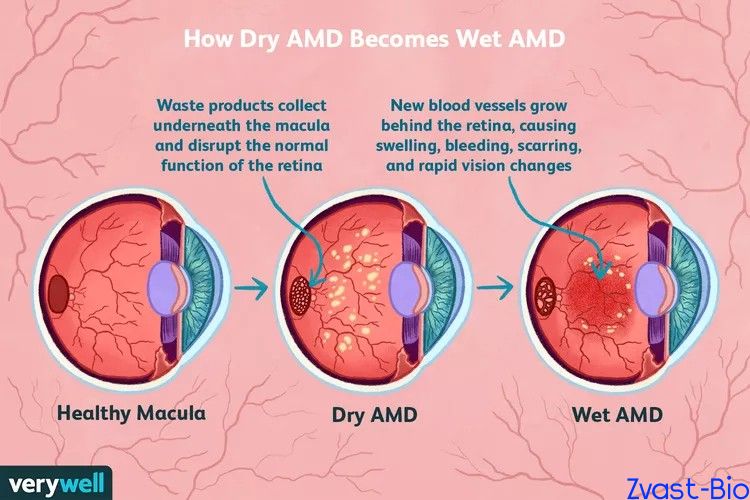
Source:inspiredpencil
- Dry AMD (accounting for 90% of patients): Its progression is relatively insidious. In the early and middle stages, the typical manifestation is the appearance of drusen (extracellular deposits) in the outer layer of the retina. These deposits will gradually induce the degeneration of photoreceptor cells, thereby leading to a decline in central vision. Some patients may develop geographic atrophy (GA) as the disease progresses, which is characterized by the confluent loss of photoreceptor cells, retinal pigment epithelial (RPE) cells, and choroidal capillaries. This damage is irreversible, and approximately 1.5 million patients in the United States are affected by GA-related vision loss.
- Wet AMD (accounting for 10% of patients): Its progression is much faster. The core pathogenesis lies in the excessive stimulation of vascular endothelial growth factor (VEGF), which leads to the formation of abnormal neovascularization in the retina. The walls of these new blood vessels are structurally fragile and prone to leaking fluid under the macula, directly damaging the function of photoreceptor cells. Central visual field scotoma is its typical clinical symptom.
Although extensive research has been conducted in the medical field to explore treatment options for AMD, there is still no radical cure worldwide due to the incomplete clarification of its pathogenesis. Recently, two key breakthroughs have been made in the field of AMD treatment, providing new therapeutic directions for patients with dry and wet AMD respectively, which are important advances in this field:
Dry AMD: Sun Yat-sen University Team Identifies New Therapeutic Target, Thalidomide Shows Potential Value
On December 30, 2025, the research results of the team from the State Key Laboratory of Sun Yat-sen University Eye Center were officially published, bringing new therapeutic ideas for patients with dry AMD, who account for 90% of the total AMD patients: Thalidomide can exert a potential therapeutic effect on dry AMD by regulating the E2F2-FBXO5 pathway and is expected to become a new drug candidate.
Source:faseb
The study confirmed that thalidomide can act precisely on retinal pigment epithelial (RPE) cells — the functional impairment of these cells is a core link in the progression of dry AMD. Specifically, thalidomide can restore the mitochondrial function of RPE cells, alleviate the G2/M phase cell cycle arrest, and at the same time inhibit the persistent endoplasmic reticulum stress caused by oxidative damage. Its core mechanism of action is to activate the transcription factor E2F2, thereby regulating the expression of FBXO5. Animal experiments further verified this conclusion: Thalidomide can improve the retinal structural abnormalities induced by oxidative stress, delay the degeneration of RPE cells, and at the same time enhance the visual function of model mice.

Source:faseb
This study clarifies the mechanism by which thalidomide coordinately regulates the cell cycle and endoplasmic reticulum homeostasis through the E2F2-FBXO5 pathway. It not only fills the gap in the lack of effective treatment methods for dry AMD but also provides key target support for the subsequent development of targeted drugs.
Wet AMD: Affordable Biosimilar Approved, Balancing Efficacy and Accessibility
On October 9, 2025, Celltrion announced that its developed EYDENZELT ® (aflibercept-boav) had been approved by the U.S. Food and Drug Administration (FDA).

Source:ainvest
- EYDENZELT is Celltrion's first ophthalmic biological product to obtain FDA approval. It also received approval from the European Commission in February 2025.
- FDA's approval was based on "comprehensive evidence including analytical, non-clinical, and clinical data", which includes the latest 52-week results of its global phase III clinical trial.
- A total of 348 patients with diabetic macular edema (DME) were enrolled in this randomized, double-masked, parallel-group, multi-center phase III trial to evaluate the therapeutic equivalence, sustained efficacy, and safety of EYDENZELT and EYLEA.
- According to the company, the study results showed that the best-corrected visual acuity (BCVA) of both treatment groups improved gradually from baseline to week 16 and remained stable within week 52. The company also noted that there were no significant differences between the two groups in secondary endpoints (such as the average change in central retinal thickness or overall safety outcomes).
From the discovery of new targets for dry AMD to the launch of affordable drugs for wet AMD, these two advances have not only promoted medical research and industrial development in the field of AMD treatment but also brought new hope for vision protection to the 196 million existing patients worldwide and the 288 million potential high-risk population in the future.
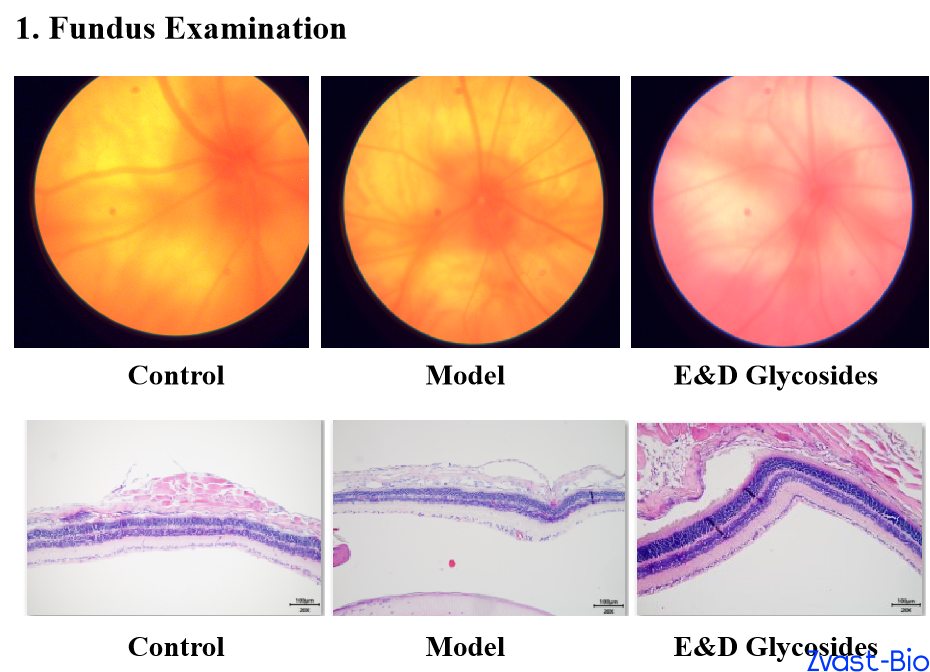
Rat Retinal Macular Degeneration Model by Zvast-bio
- Experimental Animals: ICR mice, 6-8 weeks old, male
- Model Establishment Method: After 1 week of adaptive feeding, sodium iodate was injected via the tail vein. The mice were then raised under light-shielded conditions for several days, followed by model validation.
- Positive Control Drug: Esculin and Digitalis Glycosides Eye Drops
- Experimental Cycle: 7 days
- Model Evaluation: