


Discovery of Alzheimer Disease and New Drug Developments
Discovery of Alzheimer's Disease and New Drug Developments
September 21 is World Alzheimer's Day.
Alzheimer's disease (AD) is a neurodegenerative disorder characterized by progressive cognitive decline. Currently, more than 50 million people worldwide suffer from AD or other related dementias, and this number is expected to rise to 139 million by 2050. The main pathological features of AD include beta-amyloid (Aβ) deposition and neurofibrillary tangles (NFTs) caused by hyperphosphorylation of Tau protein.
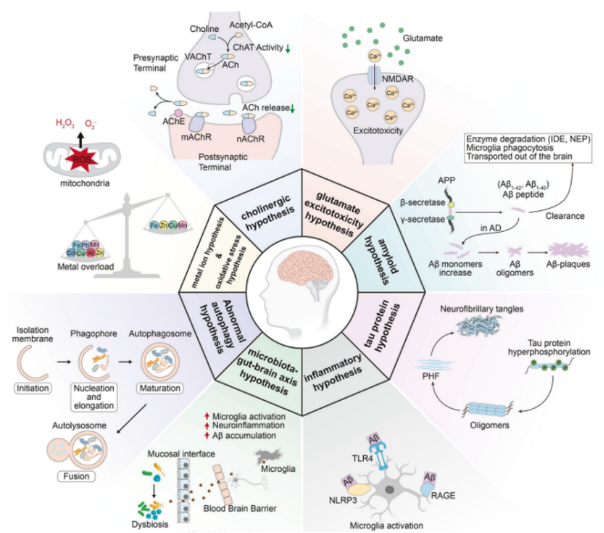
Schematic Diagram of AD Pathogenesis
Schematic Diagram of AD Pathogenesis
In November 1901, Alois Alzheimer admitted a 51-year-old female patient, Auguste Deter (1850-1906), to the Frankfurt Mental Hospital. The patient exhibited symptoms such as short-term memory loss, aphasia, disorientation, auditory hallucinations, paranoid delusions, and suffered from a progressive neuropsychiatric disorder.
In April 1906, Dieter died of Pressure ulcer sepsis. Alzheimer made significant discoveries through Dieter's brain—amyloid plaques and neurofibrillary tangles, which are now considered characteristic pathological changes of Alzheimer's disease.
On November 3, 1906, Alzheimer reported this case at the 37th Annual Meeting of Southwest German Psychiatrists, but it did not attract attention. It was not until 1910 that the famous psychiatrist Kraepelin (who was also Alzheimer's teacher) named this type of dementia after Alzheimer in the 8th edition of his published book "Psychiatry," and the term "Alzheimer's disease" officially entered the modern medical disease system and has been used ever since.

The picture shows Kraepelin's published work 'Psychiatry'
Progress in Alzheimer's Disease Medication
Since its first discovery in 1906, progress in the treatment of AD has been very slow. Before 2021, the FDA had approved only 5 AD treatment drugs. In addition, a combination of memantine and donepezil was approved in 2014. Tacrine was withdrawn from the market because its adverse reactions were too severe, with the risks outweighing the benefits.

In the past 20 years, pharmaceutical companies such as Eli Lilly, Pfizer, and Roche have invested in dozens of drugs targeting Aβ or tau, but due to insufficient efficacy or side effects, many have failed in Phase III clinical trials, with a failure rate as high as 99.6%. Examples include Eli Lilly's Solanezumab (failed three times in 2012, 2016, and 2023) and Roche's Gantenerumab (failed in 2022).
Currently, the FDA has only approved Biogen's Aducanumab (discontinued) and Lecanemab, Eli Lilly's Donanemab, and Alpha Cognition's Zunveyl for market release, with the first three all targeting Aβ amyloid protein.
Aducanumab became the first FDA-approved drug to slow down Alzheimer's disease (AD) in 2021, but it has always been controversial. On January 31, 2024, Biogen announced the cessation of the drug's development and marketing.
In July 2023, the FDA officially approved lecanemab, jointly developed by BioGen and Eisai, for the treatment of adult patients with Alzheimer's disease, making it the first new AD drug to receive full FDA approval in nearly 20 years. It was approved for marketing in China in January 2024.
On July 3, 2024, Eli Lilly's donanemab was approved by the FDA for marketing for the treatment of adult AD patients with early symptoms, and on December 18 of the same year, it was approved by the NMPA for marketing.
On July 29, 2024, Alpha Cognition announced that its oral extended-release drug Zunveyl for the treatment of Alzheimer's disease received FDA approval for marketing, intended for the treatment of mild to moderate AD. This is also the second oral therapy for AD approved by the FDA in nearly a decade (the previous one was the memantine/donepezil combination approved in 2014).
On June 3, 2025, Professor Jeffrey Cummings' team of American neuroscientists published the new annual Alzheimer's disease drug development pipeline report in the journal BMJ (IF: 93.6).
As of January 2025, there are a total of 138 Alzheimer's disease (AD) drugs undergoing 182 clinical trials worldwide. These candidate drugs involve up to 15 disease-related mechanisms, covering areas such as amyloid, tau, neuroinflammation, metabolic function, and synaptic function. Among them, approximately 74% of the drugs are disease-targeted therapies aimed at slowing or stopping disease progression, while the remaining 26% are symptomatic therapies designed to improve cognitive function or neuropsychiatric symptoms.
Animal models of Alzheimer's disease
As a core tool for simulating the progression of human diseases, verifying drug efficacy, and exploring molecular mechanisms, animal models play a central role in research. AD model animals are mainly rodents, primates, and invertebrates, including artificially induced models, transgenic models, and aging models. A detailed inventory of specific animal models has been previously conducted: an inventory of Alzheimer’s disease (AD) animal models.
Introduction to the Zvast Biotechnology AD Model
Zvast Biotechnology has a stable and reliable APPswe/PS1ΔE9 transgenic mouse model of AD, and has successfully validated the pharmacodynamic evaluation of relevant positive reference drugs on this mouse model.
Experimental mice: APPswe/PS1ΔE9 transgenic mice
Assessment indicators: Behavioral tests including the Barnes maze and open field test were conducted after continuing to rear mice aged 6-7 months for an additional 4 weeks. Subsequently, brain tissues were subjected to HE staining, and the expression levels of β-amyloid 42 (Aβ-42) and neprilysin (NEP) were measured.
Positive drug: Memantine hydrochloride tablets
Partial data display:
Behavioral Test:

2.HE staining results
The hippocampal structure in the normal group was normal, with no obvious damage to neurons observed. In the model group, the hippocampal structure showed no significant changes, but abnormal neurons were visible in local areas, with cell shrinkage and necrosis, cavities around cells, and pronounced congestion in small blood vessels in the hippocampus. In the memantine hydrochloride group, necrotic cells in the hippocampus were significantly reduced, and the congestion in small blood vessels was improved.

References:
1.Alzheimer A (1906). Über einen eigenartigen schweren Erkrankungsprozeβder Hirnrinde. Neurologisches Centralalblatt 23:1129-1136.
2.Alzheimer A (1907). Über eine eigenartige Erkrankung der Hirnrinde.Allgemeine Zeitschrift für Psychiatrie und psychisch-gerichtliche Medizin64:146-148.
3.https://www.nature.com/immersive/alzheimers-disease-history/index.html
4.Mahase E. Alzheimer's disease: Rise in new drugs being trialled sparks hope among experts. BMJ. 2025;389:r1148. Published 2025 Jun 3.