


Differentiated IL-4R Secures First-ever Global Approval for Allergic Rhinitis Indication
Differentiated IL-4R Secures First-ever Global Approval for Allergic Rhinitis Indication
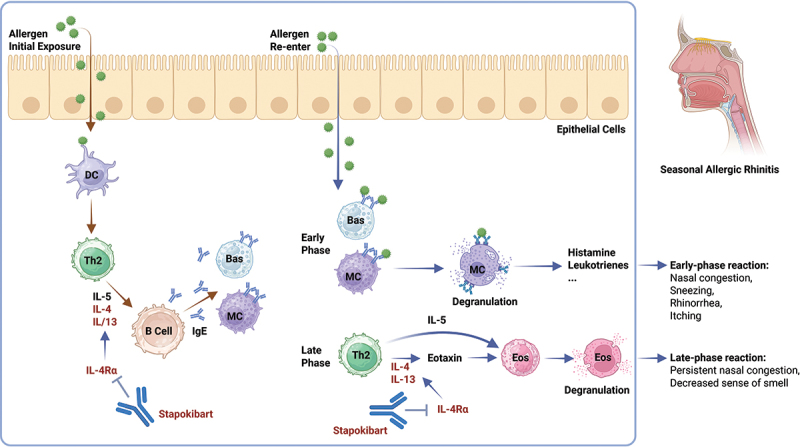
Allergic rhinitis (AR) is a common chronic inflammatory disease of the nasal mucosa, typically triggered by environmental allergens. It manifests as frequent nasal congestion, rhinorrhea, sneezing, and nasal/ocular itching. Statistics indicate that China has 240 million AR patients, over half of whom experience persistent moderate-to-severe symptoms. AR primarily exhibits type 2 inflammatory characteristics and can be classified into seasonal allergic rhinitis (SAR) and perennial allergic rhinitis (PAR), with SAR presenting more severe symptoms.
Currently, AR treatment primarily relies on corticosteroids, antihistamines, or leukotriene antagonists, but these medications only alleviate symptoms and cannot cure the condition. Biologic therapies represent targeted treatments for moderate-to-severe patients, particularly those unresponsive to standard medications.
On February 7, 2025, Canopy Biologics' Stapokibart (trade name: Kangyuedar), an IL-4Rα monoclonal antibody independently developed in China, received approval from the National Medical Products Administration (NMPA) for the treatment of seasonal allergic rhinitis (SAR). This marks the world's first approval of an IL-4Rα monoclonal antibody.
Stapokibart is a humanized monoclonal antibody targeting IL-4Rα. By specifically binding to IL-4Rα, it dual-blocks IL-4 and IL-13 signaling pathways to suppress Th2-mediated inflammation, effectively controlling allergic symptoms in the nose and eyes.
On April 4, 2025, Professor Zhang Luo's team from Beijing Tongren Hospital, affiliated with Capital Medical University, published a landmark study titled “Stapokibart for moderate-to-severe seasonal allergic rhinitis: a randomized phase 3 trial” in the internationally renowned journal Nature Medicine.
This study is a Phase 3, multicenter, randomized, double-blind, placebo-controlled clinical trial involving 108 patients with moderate-to-severe SAR and baseline blood eosinophil counts ≥300/μl. Participants were randomly assigned (1:1) to receive either 600 mg (loading dose) followed by 300 mg of stapokibart via subcutaneous injection or placebo every 2 weeks for 4 weeks. The primary endpoint was the mean change in retrospective total nasal symptom score (rTNSS) from baseline over the first 2 weeks.
Results showed that nasal congestion symptoms rapidly improved within 2 days of the first treatment; overall nasal symptoms significantly improved after 4 days; and nearly 90% of patients experienced mild or complete resolution of ocular symptoms such as eye itching and tearing after two treatments, with good safety profiles.
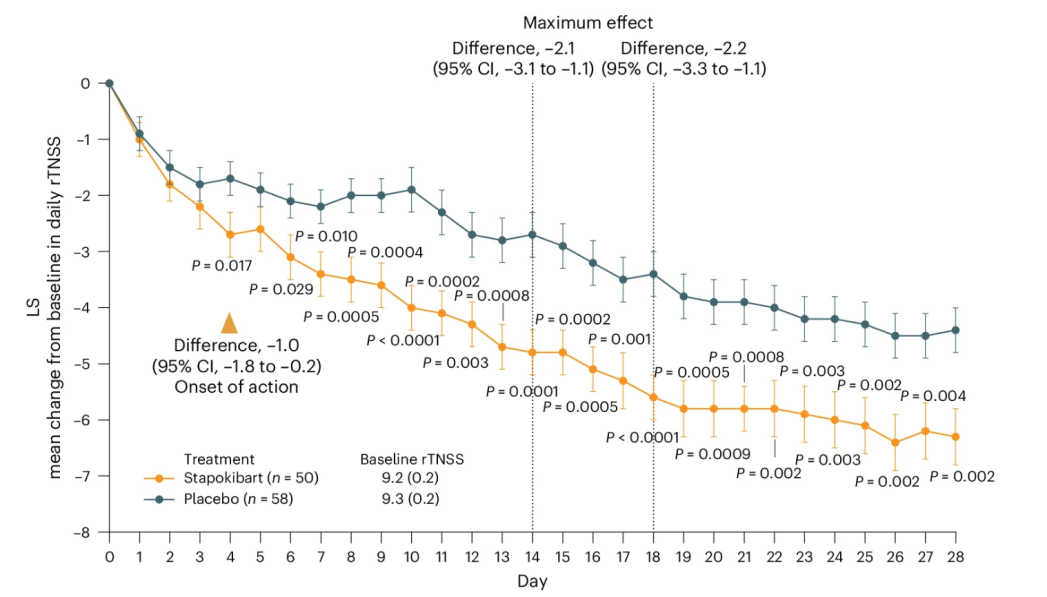
The figure shows the daily change in rTNSS relative to baseline during the 4-week treatment period.
Canopy Biologics achieved revenue of RMB 499 million in the first half of 2025, representing an 812% year-over-year increase. Sales of siputumab reached RMB 169 million, directly driving this explosive growth. Suproliumab's benchmark drug is the global autoimmune blockbuster—Sanofi's Dupilumab (brand name: Dupixent)—which generated over $14 billion in worldwide sales in 2024.
Structurally, sipulimab possesses novel CDR sequences, with CDRs determining the specificity of antibody-antigen binding. In comparison, sipulimab can completely block the interaction between IL-4Rα and IL-4, whereas dupilumab achieves only partial blockade.
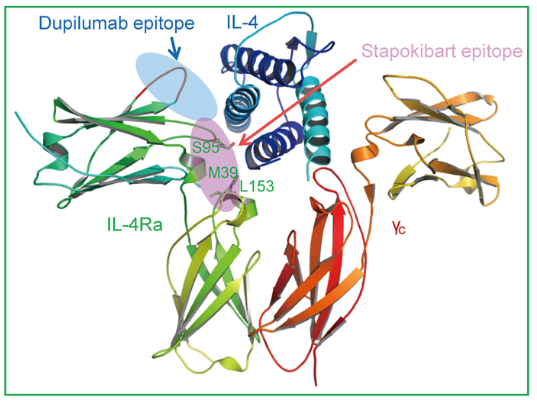
To date, dupilumab has received global approval for multiple indications including atopic dermatitis, asthma, chronic sinusitis with nasal polyps, chronic idiopathic urticaria, prurigo nodularis, as well as chronic obstructive pulmonary disease. Siproliumab strategically targets otolaryngology as its differentiated entry point. For seasonal allergic rhinitis, Siproliumab stands as the world's only IL-4Rα antibody therapy and China's sole approved monoclonal antibody treatment for allergic rhinitis.
Additionally, supusimab has been approved for the treatment of chronic sinusitis with nasal polyps and moderate-to-severe atopic dermatitis in adults. Clinical studies are currently underway for multiple additional indications, including moderate-to-severe atopic dermatitis in adolescents, prurigo nodularis, asthma, and chronic obstructive pulmonary disease.
Zvast Biotechnology Mouse Model of Allergic Rhinitis
Experimental animals: 6-8-week-old Balb/c mice
Modeling Procedure: (1) Sensitization Phase: Mice were sensitized on days 1, 5, 9, and 12 via intraperitoneal injection of OVA suspension.
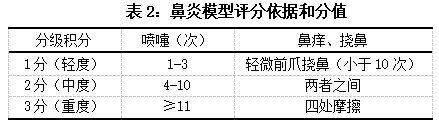
(2) Provocation phase: Instill 10 µL of OVA saline solution into the nostrils of mice in the model group and observe the number of times they scratch their noses or sneeze within 30 minutes.
Model validation: On day 12, after 30 minutes of sensitization treatment, administer a single OVA nasal instillation challenge. On day 13, administer a single OVA nasal instillation challenge and score according to the table below. A total score exceeding 3 indicates successful model establishment.
Positive drug: Fluticasone propionate nasal spray (Flixotide)
Model Evaluation: