


siRNA Drugs Boom: 8 Approved Drugs Lead the Way, Chinese Pharmaceutical Companies Compete for a New Blue Ocean
In the wave of innovative drug research and development, small interfering RNA (siRNA) drugs have evolved from the past "proof of concept" to today's "blossoming everywhere". With the approval of the world's eighth siRNA drug by the end of 2025, a clear development pattern has taken shape in this track, and the focus of future competition has emerged. Domestic pharmaceutical companies have joined the race one after another.
8 Approved Drugs Validate Technological and Commercial Potential
In 1998, American biologists Andrew Z. Fire and Craig C. Mello revealed that double-stranded RNA could trigger efficient gene silencing and named it RNA interference (RNAi). This revolutionary discovery earned them the Nobel Prize in 2006. This scientific breakthrough quickly spawned an industrial wave. In 2002, Dr. Phillip A. Sharp and Nobel laureate Craig C. Mello co-founded Alnylam Pharmaceuticals. However, as a leading enterprise in the siRNA field, it was once on the verge of collapse due to technical barriers such as defective delivery systems in the early days.
After more than a decade of intensive research, especially with the key breakthrough in liver-targeted delivery technology (such as GalNAc conjugation technology), the pipeline turned around. In 2018, the first drug Patisiran was approved, creating history. To date, eight siRNA drugs including Inclisiran and Fitusiran have been approved for marketing in the United States, Europe, China and other regions, proving the complete path from the basic discovery of siRNA, to the industrial development by Sharp and others, and finally to the successful transformation into drugs accessible to patients worldwide.
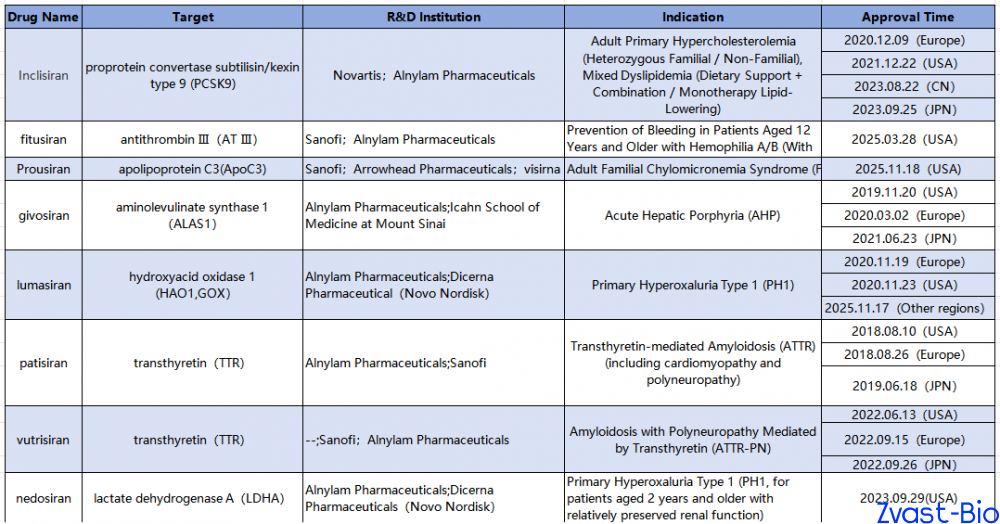
Source: Zvast-bio
This undoubtedly brings huge imagination space to the market. Global pharmaceutical giants such as Sanofi, Novartis, Roche and others have entered the market through huge cooperation or acquisitions. At present, there are more than 150 research and development pipelines worldwide, spawning an emerging market with a market value of tens of billions of US dollars.
Accelerated Competition Among Chinese Pharmaceutical Companies
The success of approved drugs has greatly stimulated the research and development of subsequent pipelines. Chinese pharmaceutical companies will naturally not miss this piece of the pie. From the data of the world's top ten enterprises with the most pipelines, we can see that Ribobio has stepped into the forefront of global siRNA research and development, and CSPC Pharmaceutical Group and Bowang Pharmaceutical also have a place.
As one of the world's earliest pioneers focusing on RNAi technology development and small nucleic acid drug research and development, Ribobio established an international R&D center Ribocure Pharmaceuticals AB in Sweden in February 2022. The company has promoted a number of products to enter Phase II clinical trials through its independently developed liver-targeted delivery technology RiboGalSTAR™. Among them, RBD1007, an siRNA drug targeting Caspase 2 for the treatment of non-arteritic anterior ischemic optic neuropathy (NAION), has currently entered the pre-Phase III clinical stage. Although Ribobio is still in a loss-making state during the R&D investment period, it is not difficult to see from the 57.6% year-on-year growth in revenue and the narrowing of losses in the first half of 2025 that it shows great potential.
On October 9th, CSPC Pharmaceutical Group announced that its independently developed Class 1 chemical new drug SYH2070 Injection (a double-stranded small interfering RNA (siRNA) drug) has been approved by the FDA to carry out clinical trials in the United States, and obtained approval from the NMPA to conduct clinical trials in China in September 2025.
Bowang Pharmaceutical has become an internationally leading siRNA enterprise by virtue of two huge transactions with Novartis (totaling 9.365 billion US dollars). Its independently developed next-generation RNAi technology platform (RADS™) can design RNA molecules with better activity, durability and safety. The company's fastest pipeline BW-01 for severe hypertriglyceridemia (sHTG) has entered Phase II clinical trials.

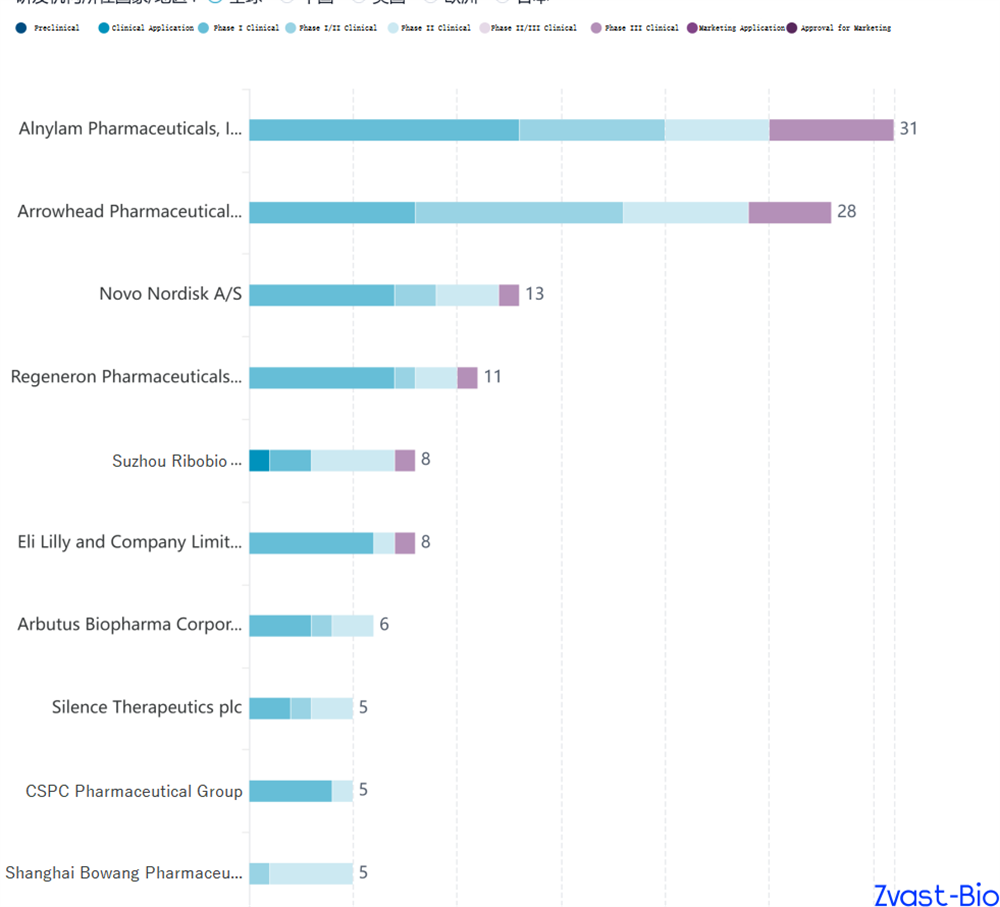
Source: Pharmcube
Early R&D Reveals Future Competitive Pattern and Hot Tracks
At present, R&D resources for siRNA drugs are highly concentrated in two major fields: cardiovascular diseases and hepatitis B. This R&D trend is technically benefited from mature liver-targeted delivery technology (such as GalNAc), making the regulation of targets related to blood lipids and metabolism in the liver (such as PCSK9, ANGPTL3, etc.) the most successful and popular R&D direction at present. In addition, the replication of hepatitis B virus (HBV) and the production of viral antigens are highly dependent on hepatocytes. Direct degradation of viral mRNA through liver-targeted delivery of siRNA reflects the huge clinical demand and R&D enthusiasm for achieving "functional cure" by directly silencing the viral genome with siRNA.
In addition, hundreds of millions of cardiovascular disease and hepatitis B patients worldwide constitute a huge market. Especially in the cardiovascular field, the successful verification of ultra-long-acting therapies by PCSK9-targeted drugs (such as Inclisiran) has brought extremely high commercial premium and market penetration rate, forming a strong demonstration effect, establishing a clear commercial success paradigm for the entire track, and attracting a large number of continuous capital inflows. Driven by these logics, the R&D pipelines of domestic pharmaceutical companies are highly concentrated in the cardiovascular and hepatitis B fields, which is an inevitable result of industrial development.
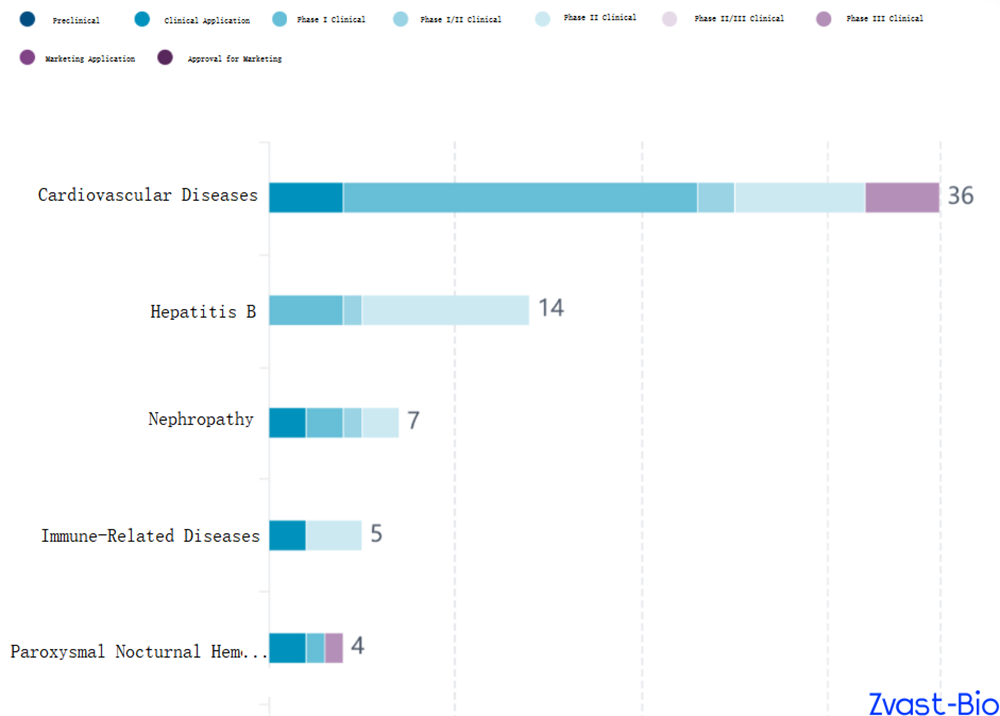
Source: Pharmcube
With the successful approval of eight global siRNA drugs, this field has completely bid farewell to proof of concept and entered a new stage of industrial explosion and commercial realization. With independent delivery platforms and international cooperation, Chinese pharmaceutical companies are transforming from fast followers to unignorable competitors in the global track. In the future, while continuing to deepen the two main tracks of cardiovascular diseases and hepatitis B, breakthroughs in next-generation delivery technology will determine who can take the lead in sailing to the broader "deep-sea" market.